


Delhi World Public School, Greater Noida
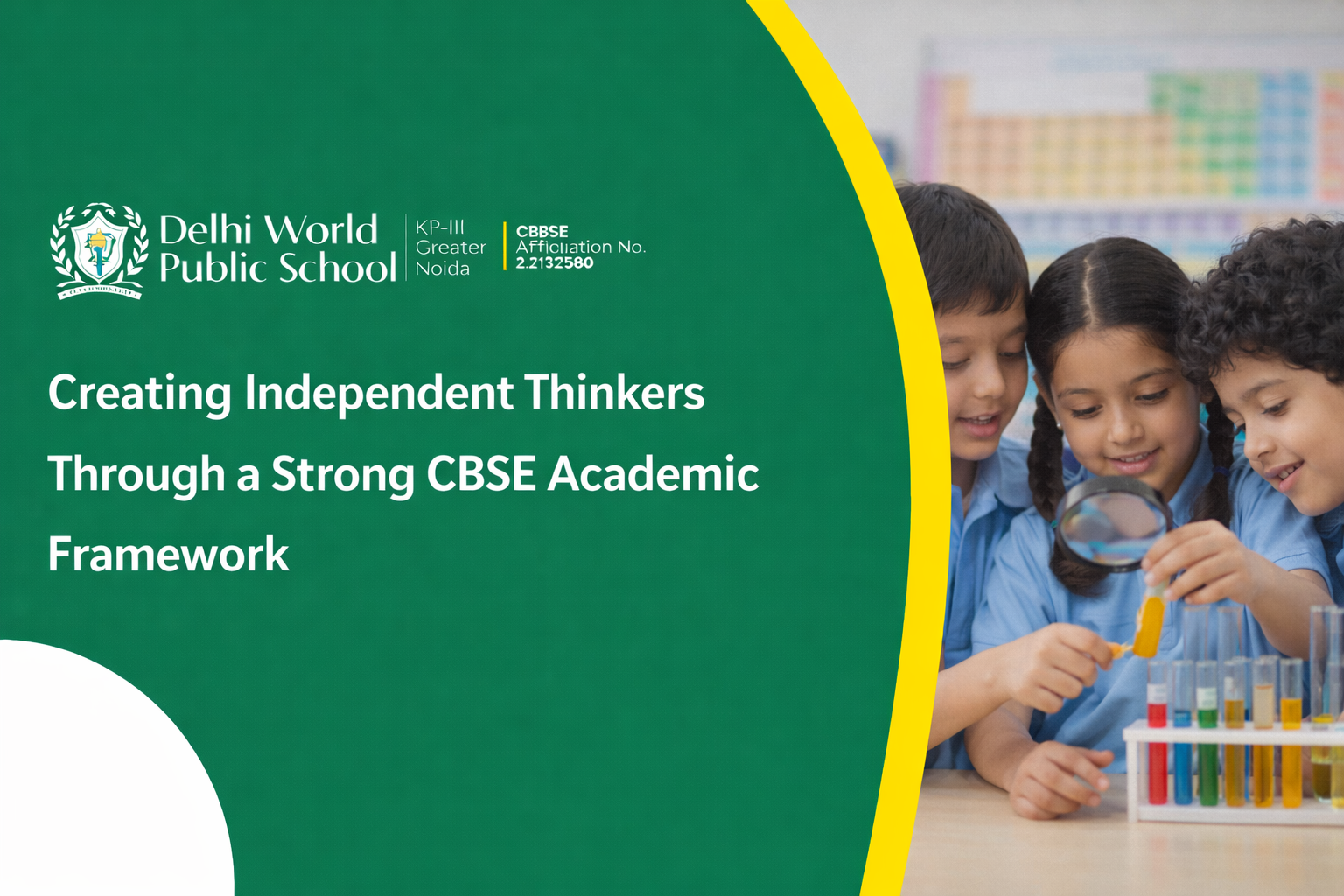
In today’s fast-changing world, education must do more than deliver information. It must empower students to think independently, question ideas, solve problems creatively, and apply knowledge meaningfully. At Delhi World Public School, the Best CBSE School in Greater Noida where a well-structured CBSE academic framework plays a transformative role. Designed to balance academic rigor with conceptual clarity, the CBSE curriculum has emerged as a powerful foundation for nurturing confident, self-driven learners.
The cbse school stands apart not merely through results, but through its ability to cultivate independent thinkers—students who are curious, analytical, adaptable, and prepared for lifelong learning. This article explores how a strong CBSE framework creates such learners and why it remains one of the most trusted educational systems in India.
Built on a robust CBSE academic framework, our school fosters independent thinking, conceptual understanding, and lifelong learning habits. Our curriculum balances disciplined study with opportunities for exploration, encouraging students to analyze, question, and apply knowledge creatively. We complement classroom learning with a wide spectrum of extracurricular programs, including debates, literature clubs, performing arts, athletics, and community service, which enhance critical thinking, communication, and teamwork. Throughout the year, students participate in academic competitions, cultural events, and leadership camps that help them build confidence and discover their unique strengths. Celebrating student achievements through annual days, talent shows, and inter-school challenges reinforces a growth mindset. With dedicated mentoring and continuous feedback, we empower students to take ownership of their learning, think independently, and thrive in an ever-changing world.
Independent thinking refers to a student’s ability to analyze information, form opinions, make decisions, and solve problems without excessive dependence on external guidance. It is not about learning in isolation, but about developing the confidence and competence to think critically and act responsibly.
Independent thinkers:
The CBSE framework, when implemented effectively, supports all these outcomes.
The CBSE curriculum is built on the principle of holistic education. It emphasizes conceptual understanding, skill development, and continuous assessment rather than rote learning.
Key goals of the CBSE framework include:
This philosophy aligns perfectly with the objective of creating independent, confident learners.
One of the strongest aspects of the CBSE framework is its focus on concept clarity. Students are encouraged to understand why and how concepts work, rather than memorizing answers.
At the cbse school, classrooms emphasize exploration, discussion, and conceptual depth, allowing students to engage actively with what they learn.
The CBSE syllabus is carefully structured to progress logically across grades. Concepts are introduced gradually and revisited at increasing levels of complexity.
This structure:
When students see how knowledge evolves, they naturally develop the habit of independent inquiry.
Modern CBSE implementation moves beyond textbooks to include hands-on activities, projects, and experiential learning.
Examples include:
Such approaches place students at the center of learning, encouraging them to explore, question, and discover independently.
CBSE’s continuous and comprehensive evaluation system focuses on assessing understanding rather than memory.
This balanced evaluation system reduces exam anxiety and allows students to reflect on their learning, identify strengths, and work on improvement areas independently.
The CBSE framework supports interdisciplinary learning, helping students see connections between subjects.
For example:
This integration develops higher-order thinking skills and helps students approach problems from multiple perspectives.
Strong communication skills empower students to express ideas clearly and confidently. The CBSE curriculum emphasizes language proficiency across subjects.
Students regularly engage in:
Such activities help students articulate thoughts, defend viewpoints, and develop self-confidence—key traits of independent thinkers.
CBSE-aligned schools encourage students to take responsibility for their learning and actions.
This is achieved through:
Responsibility nurtures self-discipline and decision-making abilities, reinforcing independence.
In a strong CBSE academic environment, teachers act as facilitators rather than information providers.
Their role includes:
This mentorship approach allows students to think independently while receiving appropriate guidance.
Digital tools, when used effectively, enhance independent learning. CBSE schools increasingly integrate technology to support research, collaboration, and creativity.
Benefits include:
Technology empowers students to take control of their learning journey.
Independent thinking extends beyond academics into real-life skills. The CBSE framework includes life skills education to prepare students for everyday challenges.
Life skills developed include:
The cbse school ensures these skills are integrated naturally into daily learning.
Creativity is a vital component of independent thinking. CBSE promotes creative expression through arts, activities, and open-ended projects.
Creative opportunities include:
When creativity is encouraged, students learn to think beyond standard solutions.
A strong CBSE environment recognizes the link between emotional well-being and independent thinking.
Supportive practices include:
Emotionally secure students are more confident in expressing ideas and taking intellectual risks.
CBSE’s national alignment prepares students for various competitive exams while maintaining conceptual strength.
Advantages include:
However, the true strength lies in preparing students to think independently rather than simply perform in exams.
Parents increasingly choose CBSE-aligned institutions because they:
The cbse school earns trust by delivering not just results, but well-rounded, confident learners.
Students who develop independent thinking skills:
These benefits extend far beyond school years.
Traditional models often emphasize memorization, while CBSE-driven learning emphasizes understanding.
CBSE approach:
This distinction defines quality education in today’s context.
A strong CBSE academic framework does more than deliver academic excellence — it creates independent thinkers who are confident, curious, and capable. By emphasizing conceptual clarity, skill development, continuous assessment, and holistic growth, the cbse school prepares students for both academic success and real-world challenges.
Education that fosters independent thinking equips learners not just to succeed in exams, but to thrive in life.
FAQs:


