


Delhi World Public School, Greater Noida
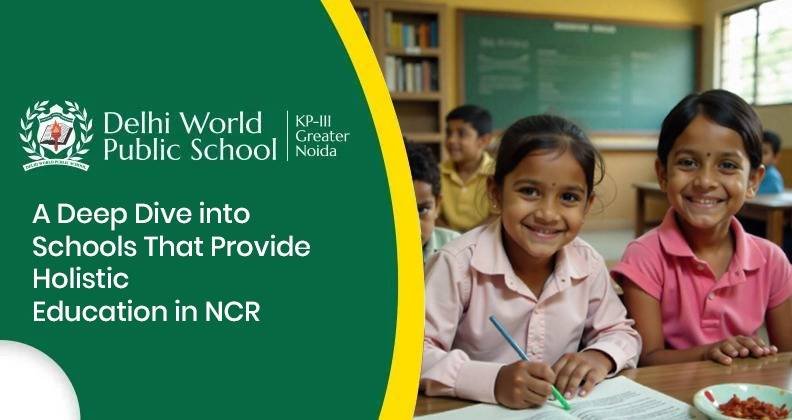
In today’s fast-changing world, the definition of education has evolved beyond academic scores and examination results. At Delhi World Public School, the Top Ten Schools in Greater Noida where parents are increasingly seeking institutions that nurture not just intellectual growth but also emotional, physical, and moral development. This balanced approach—widely known as holistic education—has become the cornerstone of modern learning.
The National Capital Region (NCR) has witnessed a major transformation in schooling over the past decade. It is now home to some of the finest institutions that believe in the power of complete education. A look at the schools reveals how holistic development is becoming the central philosophy of progressive education. These schools are shaping confident, compassionate, and creative individuals ready to take on the challenges of the future.
DWPS is committed to nurturing well-rounded individuals by integrating academics with co-curricular and extracurricular activities. The school offers a range of clubs, including Music, Dance, Photography, and Robotics, allowing students to explore their passions. Events like the Career Carnival and Ramayan: The Eternal Story of Lord Ram provide platforms for students to engage with cultural and professional topics. With a focus on emotional well-being, leadership, and community service, DWPS ensures that students develop into compassionate and competent individuals ready to contribute positively to society.
Holistic education focuses on developing all aspects of a child’s personality—intellectual, emotional, social, physical, artistic, and spiritual. It moves away from the idea that learning happens only through textbooks and examinations. Instead, it encourages experiential learning, creativity, collaboration, and empathy.
The philosophy of holistic education is based on a simple truth: Every child is unique. Education should therefore be personalized to suit individual strengths, interests, and learning styles. By emphasizing the overall well-being of the student, this approach ensures balanced growth that lasts a lifetime.
Key principles of holistic education include:
This shift towards a 360-degree approach is what sets apart modern institutions across NCR from traditional schools of the past.
The NCR region has emerged as a leading center for educational innovation in India. Once known primarily for its academic excellence, the region now emphasizes balanced learning environments that combine academics with co-curricular and social development.
Many of the institutions listed among the schools have designed their educational models around child-centric principles. Classrooms have become interactive, teachers have become mentors, and campuses have transformed into nurturing ecosystems.
Parents today no longer look for schools with just good results—they look for environments that instill confidence, curiosity, and compassion. NCR’s forward-thinking schools are responding to this expectation by adopting global teaching frameworks while preserving cultural and moral roots.
Holistic education is built upon multiple pillars that together shape a student’s personality and purpose. Let’s explore these dimensions in depth.
a. Intellectual Growth
Academic excellence remains a key focus, but it is now approached differently. Instead of rote memorization, emphasis is placed on conceptual understanding, problem-solving, and application. Students are encouraged to think critically, analyze creatively, and express freely.
Modern classrooms integrate technology and real-world learning experiences. From digital simulations to project-based learning, education is designed to make students active participants rather than passive recipients.
b. Physical Fitness and Sports
A healthy body is the foundation of a healthy mind. Schools offering holistic education provide extensive sports programs to promote physical strength, discipline, and teamwork. Students are encouraged to participate in athletics, swimming, football, basketball, and yoga—learning resilience, patience, and focus along the way.
Physical education is treated not as an extracurricular activity but as a core subject contributing to overall development.
c. Emotional and Mental Well-Being
Holistic education recognizes the importance of emotional intelligence. Counseling sessions, mindfulness practices, and mental health awareness are integrated into daily routines.
Students learn to manage emotions, build empathy, and develop self-awareness—skills that are vital for maintaining balance in today’s fast-paced world. The presence of dedicated wellness programs in many NCR schools ensures that children grow with confidence and emotional stability.
d. Artistic and Creative Expression
Art, music, dance, and theatre are powerful tools of expression and imagination. When these are included as part of the curriculum, students discover their creativity and learn to communicate ideas beyond words.
Creative pursuits foster innovation, originality, and appreciation for aesthetics—qualities that complement intellectual growth and enhance overall personality.
e. Values and Ethics
Character formation is an essential aspect of holistic learning. Schools in NCR integrate value-based lessons into academics to help students understand moral choices, empathy, and social responsibility.
Daily assemblies, moral science classes, and social awareness activities remind learners that success means little without integrity and compassion.
In today’s digital era, technology is not just an accessory but a transformative force in education. Interactive whiteboards, AI-driven assessments, and digital learning platforms have turned traditional classrooms into smart, engaging spaces.
Schools that appear effectively use technology to create personalized learning paths. Students can learn at their own pace, access global resources, and develop digital literacy from a young age.
Yet, technology is balanced with human interaction, ensuring that screen time never replaces real-world connection and communication.
Learning by doing is one of the core principles of holistic education. Instead of memorizing facts, students engage in activities, projects, and fieldwork that make concepts come alive.
Whether it’s conducting science experiments, building models, or organizing community events, experiential learning builds confidence, curiosity, and problem-solving ability. It also helps students connect academic theories to everyday life, making education more meaningful and impactful.
Many NCR schools organize regular excursions, workshops, and hands-on exhibitions to ensure that students explore, innovate, and lead.
In the modern world, where competition often overshadows compassion, schools that provide value-based education stand out. They teach integrity, respect, honesty, and kindness—not through lectures, but through practice.
Values are embedded in the culture of the school. Teachers act as role models, and students learn to appreciate diversity, fairness, and inclusion. Activities like volunteering, environmental drives, and charity initiatives help learners connect with their communities and understand their responsibilities as global citizens.
Holistic learning nurtures creativity by giving students the freedom to imagine and experiment. Art labs, robotics rooms, and maker spaces allow learners to express ideas without the fear of failure.
Such environments encourage innovation and help students develop an entrepreneurial mindset. They learn to think beyond conventional boundaries, embrace change, and find creative solutions to problems—a vital skill in today’s fast-evolving world.
A hallmark of holistic education is inclusivity. Schools that follow this philosophy ensure that every child, regardless of ability or background, feels valued and supported.
Special educators, learning support programs, and personalized teaching strategies help children with different learning needs reach their potential. By promoting diversity in classrooms, schools also teach empathy and respect for differences—laying the foundation for a more inclusive society.
Sustainability has become an integral part of holistic education. Many NCR institutions have introduced eco-clubs, green audits, and zero-waste initiatives to help students understand their responsibility toward the planet.
Children participate in plantation drives, recycling projects, and water conservation campaigns, learning that caring for nature is as important as personal success. Such initiatives instill environmental ethics early, shaping responsible global citizens.
Teachers play a transformative role in holistic education. They are not just instructors but mentors who guide, inspire, and nurture.
Trained educators use multiple teaching methods—discussion, storytelling, role play, and interactive projects—to engage students effectively. They focus on understanding each learner’s emotional and intellectual needs.
Many NCR schools invest heavily in teacher training and professional development, ensuring educators stay updated with global pedagogical trends.
Holistic education moves beyond one-dimensional testing. Continuous and comprehensive evaluation (CCE) helps assess a child’s growth across academics, skills, and personality.
Assessments now include presentations, group projects, creative portfolios, and community engagement. This method encourages reflection, self-assessment, and intrinsic motivation instead of pressure-driven competition.
Students thus see evaluation not as judgment, but as an opportunity to grow and improve.
Parents are integral to a child’s educational journey. Schools offering holistic learning recognize the importance of home-school partnerships.
Regular communication, parent-teacher meetings, and collaborative workshops ensure that parents are informed, engaged, and aligned with the school’s philosophy. Together, they create a supportive ecosystem that encourages learning both inside and outside the classroom.
Leadership is not just about holding titles—it’s about making a difference. Holistic education helps children develop leadership through student councils, team projects, and social initiatives.
Students learn to take responsibility, make decisions, and work collaboratively. Such experiences build self-confidence and empower them to contribute positively to society.
The world is increasingly interconnected, and education must prepare students to thrive globally. Schools across NCR are integrating international programs, foreign languages, and cultural exchange opportunities.
Students interact with peers from other countries through virtual collaborations, model UN conferences, and global contests. These experiences build cross-cultural understanding and broaden their worldviews, preparing them for global citizenship.
While academic and physical development are important, spiritual growth gives education its deeper meaning. Meditation sessions, mindfulness practices, and yoga classes help students cultivate inner peace, focus, and gratitude.
Spiritual education doesn’t refer to religion—it means understanding oneself and one’s purpose. This emotional depth allows learners to handle stress, maintain harmony, and develop a positive outlook toward life.
The NCR region stands at the forefront of educational transformation. With its growing emphasis on student-centered learning, experiential models, and global engagement, it serves as a blueprint for the future of schooling in India.
Institutions listed among the schools demonstrate that education can be both rigorous and compassionate, structured yet flexible. The focus has shifted from merely preparing students for exams to preparing them for life—an evolution that holds immense promise.
Parents looking for a well-rounded education can use the following checklist to identify a genuinely holistic school:
Such schools don’t just teach—they transform.
The ultimate goal of holistic education is to create self-reliant, compassionate, and future-ready individuals.
By combining intellect with empathy, creativity with discipline, and innovation with ethics, modern schools equip students with the tools needed to thrive in the 21st-century landscape. Whether they pursue careers in science, arts, entrepreneurship, or public service, these learners will carry forward values that make them both successful and humane.
Conclusion:
Education, when practiced holistically, becomes a journey of discovery—of self, society, and the world. At Delhi World Public School, the Top Ten Schools in Greater Noida where the institutions leading this movement in the NCR region prove that true learning is not limited to classrooms but continues in every experience a child encounters.
The schools represent the essence of this philosophy. Through balanced curricula, nurturing mentorship, and strong moral foundations, they are shaping the thinkers, leaders, and changemakers of tomorrow.
Holistic education is not just an academic trend—it’s a way of life. By fostering curiosity, empathy, resilience, and creativity, schools are not merely teaching children what to think, but how to think, how to feel, and how to grow into responsible, fulfilled individuals.
The result is an education that transcends grades and achievements—one that shapes complete human beings, ready to contribute meaningfully to the world.
FAQs:
Q1. What does holistic education mean?
A: Holistic education nurtures intellectual, emotional, social, physical, and ethical development, ensuring that children grow as well-rounded individuals.
Q2. How can holistic schools benefit my child’s future?
A: They equip children with life skills, emotional intelligence, creativity, and ethical values, preparing them for academic success and personal growth.
Q3. Do these schools focus only on academics?
A: No. Academics are balanced with sports, arts, social responsibility projects, leadership opportunities, and emotional well-being initiatives.
Q4. How do holistic schools handle co-curricular activities?
A: Activities like debates, community service, creative arts, and leadership programs are integrated into daily schedules to complement academics.
Q5. Can parents be involved in holistic education?
A: Yes. Schools encourage parent engagement through workshops, regular feedback, and collaboration in co-curricular events to strengthen child development.
Q6. What should parents look for when selecting a holistic school?
A: Consider teaching quality, infrastructure, co-curricular programs, emotional support, student-teacher ratios, and the school’s overall philosophy of education.


